Modern Art in Cold War Beirut by Rogers Sarah;
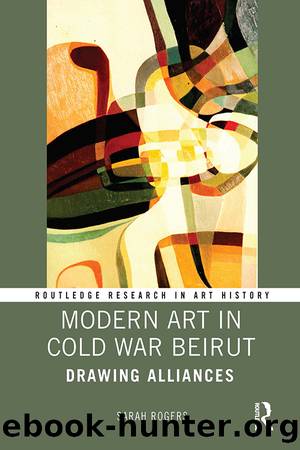
Author:Rogers, Sarah; [Sarah Rogers]
Language: eng
Format: epub
Publisher: Taylor & Francis Group
Published: 2021-04-21T00:00:00+00:00
Beirutâs Appeal, Ferrenâs Appeal
In a 1962 memo to President Kennedy, the Lebanese ambassador to the United States suggested a more aggressive cultural and commercial approach in the Middle East, especially in Lebanon, âthe showplace for the Arab world.â37 As detailed in the first chapter, the Lebanese capital of Beirut had served as a regional center for economic, political, and missionary activities since the second half of the nineteenth century. By the early 1960s, the city had developed into an artistic hub for Lebanese and Arab artists, many of whom settled in Beirut after their studies abroad in Paris and Rome. Much of Beirutâs appeal stemmed from Lebanonâs laissez-faire economy. Set in place under the French Mandate, the countryâs open political economy molded Beirut into a regional capital for international commerce, trade, and tourism. This, coupled with the countryâs relaxed censorship laws, attracted to the capital a broad mix of businesspeople, journalists, writers, artists, and tourists. Moreover, Lebanonâs national identity as a crossroads between East and West primed its pro-Western foreign policy and potential strategic use to the United States.
In 1963, only a year after the Lebanese ambassadorâs memo to Kennedy, the USIA initiated its sponsorship of artistsâ residencies abroad with Lebanon. Ferren was an easy choice to launch the program. Despite the precarious beginnings of abstraction in United Statesâyoked as it was to leftist politics during the witch hunts of McCarthy and Donderoâby the early 1960s, the formal languages of modernism had survived a stunning turn of fate. As art historians have documented, abstraction had been popularized through the mass media, the staunch efforts of individuals such as MoMAâs Alfred H. Barr, Jr. and the Whitneyâs Lloyd Goodrich, and government agencies.38 Framed as a representation of the individuality and freedom posited by the United States government as national values, abstract expressionism in particular marked the ascent of American art on the global stage. In similar terms, representatives for the State Department explained their choice of Ferren in a 1964 Newsweek article: âAs an abstract expressionist, he is a member of a distinctly American school.â39 Despite formal affiliations with his American peers, Ferrenâs artistic trajectory suggests certain differences as well, ones that would later position him as an ideal candidate for the USIAâs involvement in Beirut: his francophone beginnings and his service in the Office of War Information.
Born in Oregon in 1905, Ferren moved to Los Angeles with his family before the restlessness of young adulthood brought him to San Francisco. There he had his first seemingly accidental encounter with art-making; on his way to work as an engineer for the phone company, Ferren passed an art supply store with plasticine in the windows. Curious, Ferren purchased some and began to model small clay busts and figures. Soon after, Ferren took a job in an Italian stone yard, where he worked for the next four years. In 1929, he traveled to Europe, where once again, apparent happenchance shaped his career. At the time, Ferren didnât speak French. Drawn to the familiar sounds of his native language on a beach in St.
Download
This site does not store any files on its server. We only index and link to content provided by other sites. Please contact the content providers to delete copyright contents if any and email us, we'll remove relevant links or contents immediately.
Hyperculture by Byung-Chul Han(631)
The European Opportunity by Felipe Fernández-Armesto(623)
Morgan Kaufmann Digital Watermarking and Steganography by Ingemar Cox Matthew Miller Jeffrey Bloom Jessica Fridrich Ton(615)
The European History Highway: A Guide to Internet Resources by Dennis A. Trinkle Scott A. Merriman(582)
The Seven Wonders of the Ancient World by Michael Denis Higgins(571)
European Security without the Soviet Union by Stuart Croft Phil Williams(549)
The Routledge companion to Christian ethics by D. Stephen Long Rebekah L. Miles(546)
European Security in a Global Context by Thierry Tardy(544)
Get Real with Storytime by Julie Dietzel-Glair & Marianne Crandall Follis(498)
Gorbachev And His Generals by William C. Green(483)
Hudud Al-'Alam 'The Regions of the World' - a Persian Geography 372 A.H. (982 AD) by V. V. Minorsky & C. E. Bosworth(480)
Inheriting Walter Benjamin by Gerhard Richter;(476)
Tibetan Studies in Comparative Perspective by Chih-yu Shih Yu-Wen Chen(471)
CliffsNotes on Fitzgerald's The Great Gatsby by Kate Maurer(465)
Governance, Growth and Global Leadership by Espen Moe(464)
The Master Builder by Henrik Ibsen--Delphi Classics (Illustrated) by Henrik Ibsen(460)
How Languages Are Learned 5th Edition by Patsy M Lightbown;Nina Spada; & Nina Spada(452)
The Oxford History of the World by Fernández-Armesto Felipe;(436)
The Oxford Handbook of the Incas by Sonia Alconini(422)
